
Have you ever wondered where every Ringgit your company earns or spends really goes? Not just in theory, but in a place that tracks it all — line by line, account by account. That place is called the General Ledger (GL), and if accounting were a body, the GL would be the heart that keeps everything alive.
What Is a General Ledger?
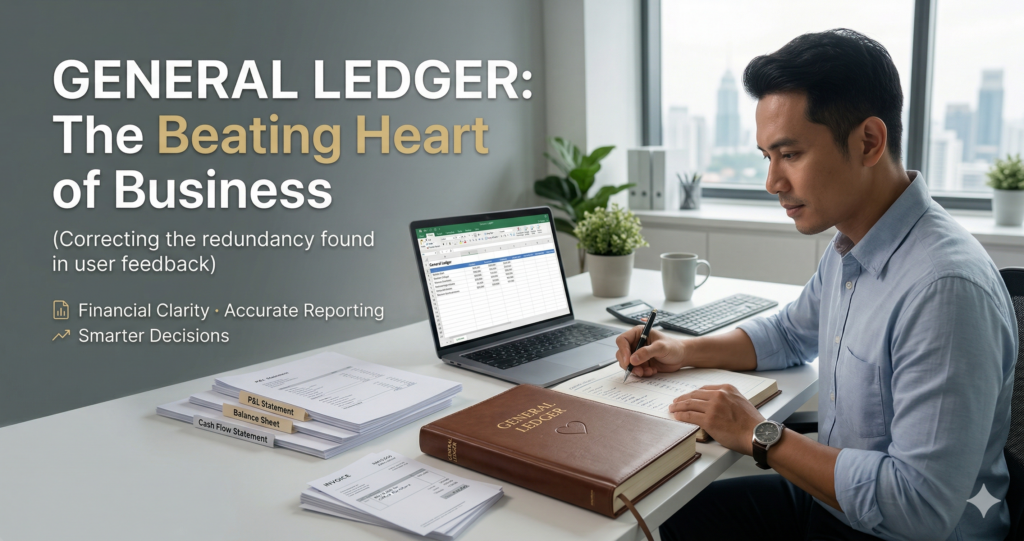
The General Ledger is the master record book of your business. Every sale, every expense, every loan payment, every asset purchase — it all ends up here. Whether you run a small consultancy or a multinational corporation, every financial system ultimately connects to the GL.
It’s the central source of truth that feeds your financial statements:
- Profit & Loss Statement (P&L)
- Balance Sheet
- Cash Flow Statement
Without the GL, those reports are just isolated numbers with no connection.
Why the General Ledger Matters
Many business owners focus on revenue and expenses, but the real insight lies in how those numbers move between accounts. The General Ledger shows the path of money — not just the totals.
Here’s why it matters:
✅ Financial clarity. Every transaction is tracked and categorized correctly.
✅ Accurate reporting. Enables reliable preparation of P&L, Balance Sheet, and Cash Flow statements.
✅ Audit-ready records. Creates a clear trail for compliance and verification.
✅ Smarter business insights. Helps you analyze performance and plan decisions with real data.
Example: How a Simple Transaction Flows Into the GL
Let’s say your company buys office furniture worth RM10,000.
Here’s the journal entry:
- Debit: Furniture (Asset)
- Credit: Cash or Bank (Asset)
This simple entry flows into your General Ledger. The furniture account increases your assets, while your cash account decreases.
When hundreds or thousands of transactions like this are combined, they form a complete financial picture — showing exactly how your money moves, grows, and gets spent.
The 5 Main Categories of a General Ledger
Every GL is organized into five main account headers, which together form your business’s financial DNA:
| Category | Examples | Purpose |
|---|---|---|
| Assets | Cash, Accounts Receivable, Fixed Assets | What your company owns |
| Liabilities | Accounts Payable, Loans, Accruals | What your company owes |
| Equity | Share Capital, Retained Earnings | Owner’s value in the business |
| Revenue | Sales, Service Income | Income generated from business activities |
| Expenses | Salaries, Rent, Utilities | Costs of running the business |
These categories work under the double-entry accounting principle — every debit must have a matching credit. That balance keeps your books accurate.
The Real-World Payoff
A well-maintained General Ledger isn’t just an accounting formality. It’s a decision-making engine.
With a clean GL, you can:
- Spot financial leaks before they become serious.
- Identify trends in sales and expenses.
- Make informed budgeting and investment decisions.
- Gain credibility with auditors, banks, and investors.
Your GL tells the story of your business in numbers. It’s how you prove stability, performance, and growth — not just to outsiders, but to yourself.
Final Thoughts
The General Ledger isn’t just a spreadsheet or software feature. It’s the foundation of financial truth in your business.
Without it, you’re steering blind. With it, you’re making every decision based on real, traceable data.
💡 In short: The General Ledger doesn’t just keep your accounts balanced — it keeps your business alive.
Financial Truth Starts with Operational Excellence
A clean General Ledger is only possible when your internal processes and HR policies are built for accuracy. At SHERA Consultancy, we help organizations optimize their SOPs and HR Policies to ensure every transaction, from payroll to operational expenses is tracked with precision.
Need to strengthen your organizational framework?
👉 WhatsApp Our Team: 016-2649847 (Mrs Badariyah)
📩 Email: [email protected]
🌐 Visit: www.sheraconsultancy.com/consultancy
SHERA Consultancy – Partnering for Strategic Excellence.