
“We hired below budget. Great job!”
It sounds like smart business. But in reality, it’s the beginning of a slow, expensive mistake.
Let’s be honest—every company wants to optimize costs. Yet when that mindset slips into compensation decisions, it often backfires. The illusion of saving a few hundred dollars a month can quietly turn into thousands lost in turnover, low engagement, and poor performance.
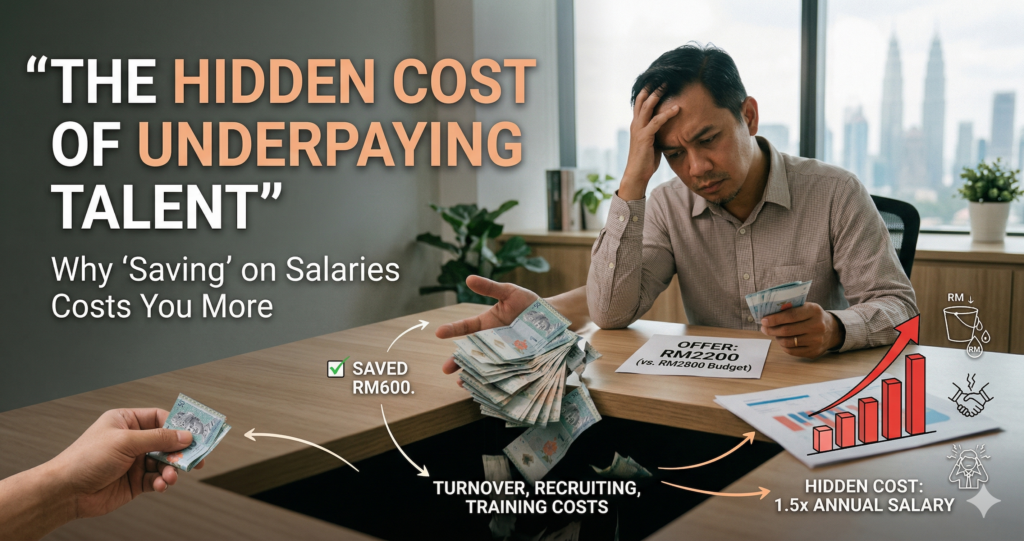
The Real Cost of Underpaying
Imagine this:
You budgeted RM2,800 for a new role. The candidate asked for RM2,500. After some back-and-forth, you closed at RM2,200.
You celebrate. On paper, you’ve “saved” RM600 every month.
But what happens next?
The new hire soon learns that others in the same position earn RM2,700 or more. Their motivation drops. Productivity slows. Within months, they resign.
Now you’re back to square one:
recruiting, interviewing, onboarding, retraining—and losing time, morale, and credibility along the way.
That RM600 “saving”? It’s gone in a single recruitment cycle.
The Psychology Behind Pay Fairness
People don’t just work for money. They work for meaning, respect, and fairness.
When employees feel underpaid compared to peers, it doesn’t just affect their wallet—it hits their sense of worth.
Fair pay signals trust and recognition. It tells your team, “We see your value.”
Underpaying, on the other hand, says the opposite: “We’ll give you as little as we can get away with.”
That kind of message spreads faster than any internal memo.
The Ripple Effect on Culture
One underpaid, unhappy employee can quietly influence an entire team.
They disengage, they stop going the extra mile, and soon others notice.
Morale dips. Collaboration fades. Turnover follows.
In HR terms, that’s not just a people issue—it’s a business risk.
A disengaged team costs real money: lower output, slower growth, and more mistakes.
Replacing just one mid-level employee can cost up to 1.5x their annual salary when you add hiring, training, and lost productivity.
Suddenly that “saving” looks like an expensive shortcut.
Pay Fair, Win Long-Term
Fair compensation isn’t about being generous—it’s about being strategic.
Here’s how smart companies handle it:
- Benchmark salaries regularly. Use reliable market data to understand where your pay stands in your industry and region.
- Be transparent about pay philosophy. Let employees know how compensation is determined and reviewed.
- Offer value beyond salary. Benefits, flexibility, learning opportunities, and recognition matter too.
- Reward loyalty and results. Incremental raises and clear growth paths build trust and retention.
Paying fairly from Day 1 builds a foundation of loyalty. Employees who feel valued stay longer, perform better, and become your brand advocates.
The Bottom Line
Underpaying talent might look like saving money, but it’s actually borrowing trouble.
You might save today, but you’ll spend far more tomorrow fixing the consequences.
Fair pay is not just an expense—it’s an investment in stability, trust, and performance.
When you hire right and pay right, you’re not just filling a role.
You’re building a team that stays, grows, and drives real results.
Hiring Right Starts with the Right Strategy
Don’t let a “budget saving” mindset lead to a costly turnover cycle. At SHERA Consultancy, through our recruitment arm Pillar Workforce Solutions, we help you find and secure top-tier talent while ensuring your compensation strategy is benchmarked for long-term retention.
Need help securing the right talent?
👉 WhatsApp Our Team: 016-2649847 (Mrs Badariyah)
📩 Email: [email protected]
🌐 Visit: www.sheraconsultancy.com/executive-search
SHERA Consultancy – Partnering for Strategic Excellence.